

Israel’s strikes on Iran have thrust foreign policy back into the issue spotlight. Foreign policy has proven to be a contentious issue among Republicans as some want stop America’s involvement in “endless wars“ while others believe the US must take a leadership role.
From our latest numbers for Winning the Issues (June 12-14), the heightened foreign policy threats over the past year appear to have had an impact on how the electorate views US alliances. Compared to June of last year, we have seen an increase in the importance that voters place on alliances that the US has with other countries.
Last June, we found that 61% found alliances to be very important compared to 68% presently. Among Republicans, the percentages of very important have increased from 59% to 64%. Among conservative Republicans, there has been an 8-point increase.
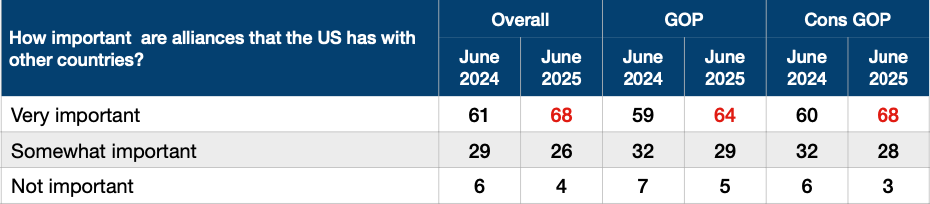
As we had pointed out in Discussion Points last July, younger Republicans were less likely to value alliances compared to older Republicans. Republicans over age 45 view the alliances that the US has with other countries as being very important (64%) rather than somewhat important (27%), while among Republicans 18-44, there is a much a larger percentage viewing them as only somewhat important (42%) rather than very important (49%). The latest numbers show some increase in importance among younger Republicans, with the percentage of very important increasing from 49% to 53%.
In addition to Republicans, we see increases in other groups:
- Independents: 64% very important, up from 57% in 2024
- Democrats: 75% very important, up from 67% in 2024.
Particularly since the withdrawal from Afghanistan, there has been a belief that America’s adversaries have been emboldened and are taking unprecedented aggressive actions. In that global context, these numbers indicate that the electorate believes that America should not go it alone.