

Here are initial takeaways from preliminary exit polls (these are not final). The current House generic margin is +10D which exceeds the margins in 2006 (+8D) and 2018 (+8.6D).
1.) Independents were a central force in the election outcome.
• Preliminary exit polls show Republicans losing independents by -17. This compares to -18 in 2006 and -12 in 2018. We are seeing the same trend in several Senate races.
• As shown in the chart below, independents are on par with both parties in terms of party ID. Since 2024, Democrats increased by 2, Republicans decreased by 2 and independents sustained their 2024 percentage. This is a slight improvement for Democrats from 2024 but all three parties were within one point of each other.

2.) This election was about the economy — again. Of a series of six issues, the economy was the most important (39), followed by state of democracy 32, immigration 14, health care 8, foreign policy 4, crime 3. Democrats won economy voters 51-46.
• The electorate’s outlook on the economy was negative (Excellent/good 25; not so good/poor 75.) This was an even worse outlook than 2024 voter outlook (31-68).
• Inflation was viewed as a hardship (21% severe hardship, 58% moderate hardship, 21% no hardship at all.)
• Tariffs were seen as hurting the economy (65% hurt, 22% helped, 13% no difference).
• On economy issue handling, Republicans trailed 43-37 D-R, 19% neither.
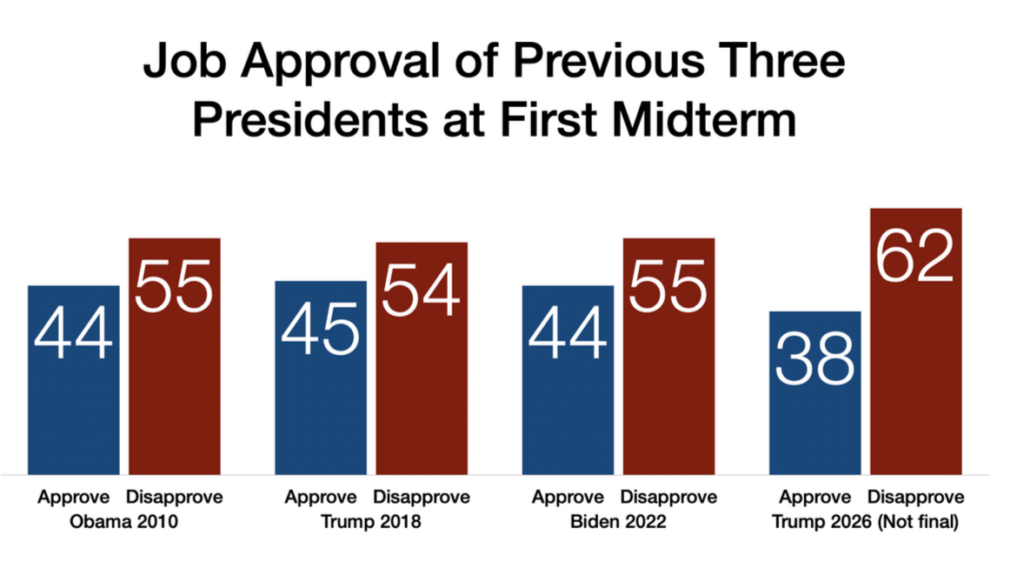
3.) Presidential job approval was negative at 38-62. This job approval is much worse compared to three previous presidents in their first midterms: Biden 2022: 44-55; Trump 2018: 45-54; Obama 2010: 44-55.
4.) Both parties were viewed negatively (Republican Party, 41-59 favorable-unfavorable; Democratic Party, 47-53). Among those that had a negative view of both parties (15%), Democrats won 59-34, a margin of 25.
Overall, this is clearly a huge win for Democrats but not necessarily an endorsement of a leftist policy direction.