
We have new numbers for Winning the Issues (October 15-16, 1000 registered voters) on the state of the federal government shutdown. Is either side moving the needle? Here are initial takeaways:
1.) There has been little impact on views of the two parties compared to views that existed before the shutdown began. Prior to the shutdown, Congressional Republicans’ brand image was 39-56 favorable-unfavorable; this is unchanged. For Democrats, their pre-shutdown brand image was unfavorable (41-51) with a slight increase in unfavorables (now 40-54). But on the whole, neither party’s standing has changed dramatically.
2.) Impact of the shutdown: At this point, most voters (54%) say the shutdown impact on them is little to none, with 30% saying it impacts them somewhat, and only 10% saying it impacts them a lot. This result is similar across party.
As we have seen throughout the summer, economic concerns continue to increase. Inflation is seen as getting worse at 57%, up from 52% in August, and 49% in June. While the personal impact of the shutdown is seen as “little to none,” the shutdown is seen as not helpful to the economy. 63% believe the government shutdown is having a serious impact on the US economy (63-22). The direct impact of the shutdown tends to be seen as minimal, but its perceived economic impact is more significant. For Republicans, this could be the more problematic aspect of the shutdown.
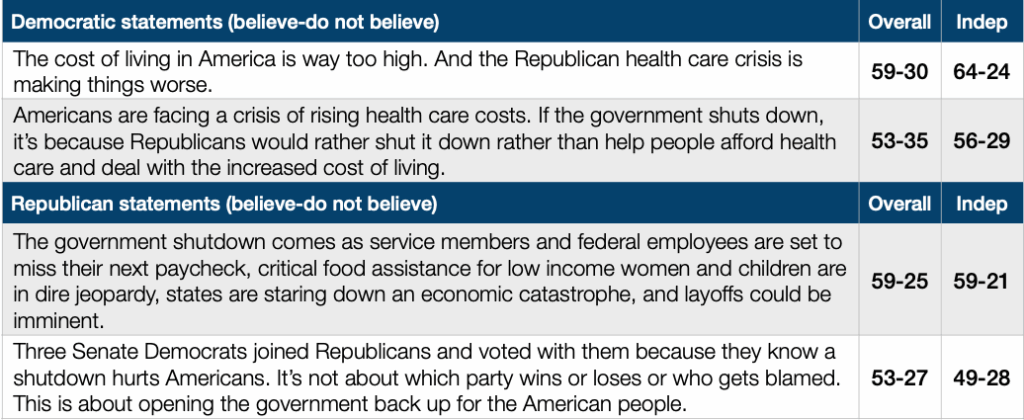
3.) Voters can see merits to both sides of the argument. The chart below shows two statements from both sides with belief over 50%. Note that the most effective Democratic statements are about tying health care to cost of living.
4.) Although there are statements from both sides that have standing with the electorate, most voters believe the shutdown is not worth it (29-53 worth it-not worth it).
5.) Reaction to Schumer’s statement that “Every day gets better for us:” On the statement that Democrats say that every day the shutdown continues, things get better for them, voters disagree with that statement 2:1 (21-52 agree-disagree). Even among Democrats, there is a mixed response (29-37 agree-disagree, 34% don’t know).