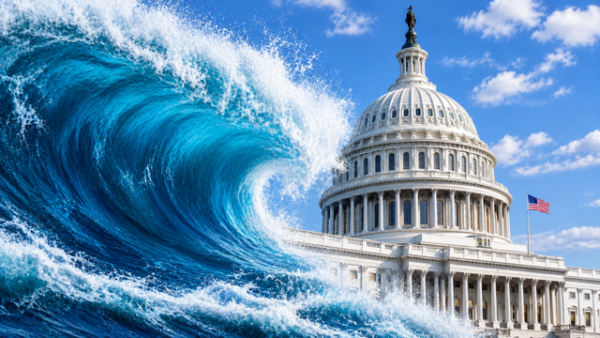

Democrats are betting on a Blue Wave and are likely to interpret a win as a mandate. But last week, Charlie Cook made an insightful observation about a more appropriate description of what a Democratic win might be:
While many have long predicted that Democrats will enjoy a “blue wave” election, I think of it more as a “red undertow,” which will pull many Republicans under and significantly trim the margins for many others. A blue wave implies an endorsement or affirmation of Democrats and their policies. But Democrats’ brand is still in tatters from 2021-2025, particularly 2021 and 2022, when they not only had President Biden in the White House but also majorities in the Senate and House. Fortunately for Democrats, this election will in most cases not be about them. It will, of course, be mostly about the occupant of the White House.
From our latest survey for Winning the Issues (September 12-16), President Trump’s job approval is 36-60 approve-disapprove. This morning, the Real Clear Politics average showed his job approval at 38-59. However, without a positive view of the winning party, it would be difficult to interpret a win as a mandate for implementation of their policies.
From our survey, the brand images for both parties are negative at similar levels: 39-58 favorable-unfavorable for Republicans in Congress; 40-56 for Democrats in Congress. Independents have an even more negative view of both: 27-69 for Republicans, 32-64 for Democrats. Twenty-five percent of the overall electorate and 44% of independents are unfavorable to both.

Democrats can still get their Blue Wave, but it could be harder for them to get there this time.
2018: In the last Blue Wave election of 2018, Democrats had a brand advantage over Republicans: 48-47 for Democrats, compared to 44-52 for Republicans. The electorate had more of a neutral view of Democrats than a positive, but it was significantly better than that of Republicans.
2022: In 2022, exit polls showed the brand images of both parties being equally negative: 44-53 for Democrats 44-52 for Republicans. In that cycle, the Republican Red Wave didn’t materialize as expected, and the party’s brand image played a role in the underperformance with independents. Among independents, Democrats were at 43-53 favorable-unfavorable, while Republicans were at 33-63.
With a large portion of the electorate being unfavorable to both, this could lead to late decision-making, with voters making up their minds in the last week potentially being the deciding factor in tight races.
For more on the House competitive landscape and past wave elections, see our latest podcast: Betting On A Blue Wave? The Election Wild Card To Watch.