Republicans are facing several headwinds for the election, including the president’s job approval and their slippage on economic issue handling. In terms of the cards they have left to play, Republicans may be trusting in their cash advantages, but we think the best card they have to play is their proximity to a center-right electorate.
From our survey (September 12-16), we asked voters to place themselves on a scale of 1-9, 1 being very liberal, 5 being moderate, and 9 being very conservative. They placed themselves at a 5.38, a center-right position.
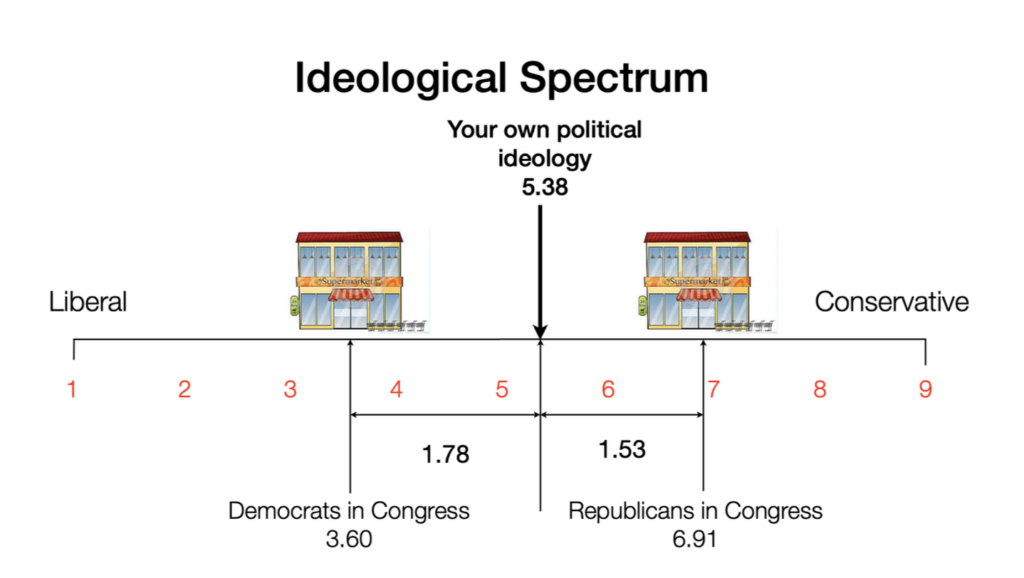
We then asked them to place where they think Republicans and Democrats are. The electorate views Republicans as being ideologically closer (a distance of 1.53) to them than to Democrats (1.78). In economic terms, this is referred to as economic distance, the cost of time and effort that makes a consumer have a preference for one store over another. In political terms, this is a closer alignment in issue priorities and ideology. Republicans have the ideological advantage, but the key is also having products that address the consumer’s needs. These are policies that enhance the economic opportunities and outcomes for individuals and families. If a “store” is not addressing those needs, consumers will look for other stores.
In this election cycle, we are seeing examples of Democratic candidates like James Talarico and Abdul El-Sayed walking back past statements to reposition themselves as centrists. They recognize that certain statements put them at a farther ideological distance from voters in their states and are trying to close that gap. The question is will voters buy it?
For more on the midterm election, see our latest podcast episode Senate Race Roundup.